distfcn
R2026bSyntax
Description
fx = distfcn(mdl)fx of the AcceleratedLifeModel object mdl, evaluated at 100 equally
spaced time values. You can specify custom evaluation times by setting the
EvaluationTimes name-value argument. distfcn
calculates the survivor function values at the stressor level in
mdl.BaselineStressorLevel. If
mdl.BaselineStressorLevel is empty, distfcn
uses the last unique stressor level in mdl.StressorLevels.
[___] = distfcn(
calculates the survivor function values at the stressor level specified by
mdl,stressorLevel)stressorLevel. Use this syntax with any of the output argument
combinations in the previous syntaxes.
[___] = distfcn(___,
specifies options in addition to one or more name-value arguments using any of the input or
output argument combinations in the previous syntaxes. For example,
Name=Value)Type="cdf" specifies to return the cumulative distribution function
(cdf) values of mdl.
Examples
Load the partFailure data set, which contains simulated observations of failure times for an assembly line part at specific humidity and temperature levels.
load partFailure.matFit an accelerated life model to the data in the partFailure table using the fitacclife function. Use the FailureTime table variable as the failure times, and the other table variables as the stressors.
mdl = fitacclife(partFailure,"FailureTime");Compute the survivor function values of the model at 100 equally spaced times. By default, the function uses the lowest unique stressor level in mdl.StressorLevels. In this example, the lowest unique stressor level corresponds to a humidity value of 50% and a temperature of 5 degrees Celsius.
[fx,T] = distfcn(mdl);
Plot the survivor function.
plot(T,fx,"+-")
xlabel("Time")
ylabel("Survivor Function")
title("Survivor Function for Humidity=50, Temperature=5")
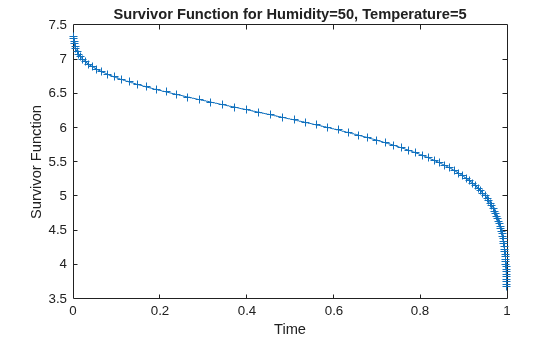
The plot shows that, at this stressor level, the assembly line part has a survival probability close to 100% for time values smaller than 4. The survival probability drops to approximately zero for time values greater than 7.5.
Load the diodeFailure data set, which contains simulated observations of failure times for a diode at different current levels.
load diodeFailure.matFit an accelerated life model to the data in the diodeFailure table using the fitacclife function. Use the FailureTime table variable as the failure times.
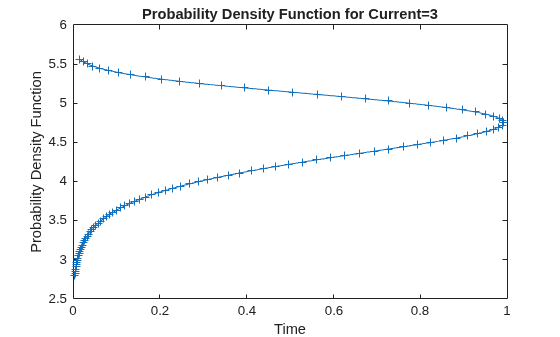
mdl = fitacclife(diodeFailure,"FailureTime");Compute the probability density function (pdf) values of the model. By default, the software calculates the pdf at 100 evenly spaced times, using the lowest unique stressor level in mdl.StressorLevels. In this data set, the lowest unique stressor level corresponds to a current level of 3 amperes.
[p,T] = distfcn(mdl,Type="pdf");Plot the pdf.
plot(T,p,"+-")
xlabel("Time")
ylabel("Probability Density Function")
title("Probability Density Function for Current=3")
Input Arguments
Name-Value Arguments
Output Arguments
More About
Version History
Introduced in R2026a
See Also
fitacclife | AcceleratedLifeModel | accelfactor | coefci | distplot | icdf | meanfailplot | meanfailtime | probplot

