allbetween
R2026bSyntax
Description
specifies the table or timetable variables to operate on in addition to any of the input
argument combinations in previous syntaxes. For example, for table tf = allbetween(___,DataVariables=vars)A,
allbetween(A,lower,upper,DataVariables="Var1") determines if elements
in table variable Var1 are within the specified range.
Examples
Create a row vector, and determine if all elements in the vector are within [2, 7].
A = [1 3 5 7 9]; tf = allbetween(A,2,7)
tf = logical
0
To determine which elements are outside the specified range, use the isbetween function.
Create a row vector, and determine if all elements in the vector are within (1, 10). Specify the interval type as "open" to exclude the lower and upper bounds.
A = 1:7;
tf = allbetween(A,1,10,"open")tf = logical
0
The result is logical 0 (false) because the first element in the vector is equal to the lower bound. Include the lower bound in the allowed range by specifying the interval type as "closedleft".
tf2 = allbetween(A,1,10,"closedleft")tf2 = logical
1
Create a table with two variables of different data types.
num = rand(6,1); dt = datetime(2016:2021,1,1)'; T = table(num,dt)
T = 6×2 table
num dt
_______ ___________
0.81472 01-Jan-2016
0.90579 01-Jan-2017
0.12699 01-Jan-2018
0.91338 01-Jan-2019
0.63236 01-Jan-2020
0.09754 01-Jan-2021
Specify the bounds for variables of different data types in one-row tables.
lower = table(0,datetime(2018,1,1),VariableNames=["num" "dt"])
lower = 1×2 table
num dt
___ ___________
0 01-Jan-2018
upper = table(Inf,datetime(2020,1,1),VariableNames=["num" "dt"])
upper = 1×2 table
num dt
___ ___________
Inf 01-Jan-2020
Determine if all elements in the num variable are within the specified range.
tf = allbetween(T,lower,upper,DataVariables="num")tf = logical
1
Determine if all elements in both variables are within the specified ranges.
tf2 = allbetween(T,lower,upper)
tf2 = logical
0
Input Arguments
Input data, specified as a scalar, vector, matrix, multidimensional array, table, or timetable.
A must be an object with the class methods lt
(<) or le (<=).
Data Types: single | double | int8 | int16 | int32 | int64 | uint8 | uint16 | uint32 | uint64 | logical | char | string | categorical | datetime | duration | table | timetable
Lower bound of the range, specified as a scalar, vector, matrix, multidimensional
array, table, or timetable. lower must be an object with the class
methods lt (<) or le (<=).
| Input Data Type | Bound Behavior | How to Specify lower |
|---|---|---|
| Array | Same lower bound for all elements of A | Scalar |
| Array | Different lower bound for each column of A | Row vector |
| Array | Different lower bound for each row of A | Column vector |
| Array | Same bound for all elements of A | Array of the same size as A |
| Table or timetable | Same lower bound for all elements of A | Scalar |
| Table or timetable | Different lower bound for each variable of A | One-row table or timetable with variables from A |
| Table or timetable | Different lower bound for each element of A | Table or timetable with the same variable names and number of rows as
A |
Upper bound of the range, specified as a scalar, vector, matrix, multidimensional
array, table, or timetable. upper must be an object with the class
methods lt (<) or le (<=).
| Input Data Type | Bound Behavior | How to Specify upper |
|---|---|---|
| Array | Same upper bound for all elements of A | Scalar |
| Array | Different upper bound for each column of A | Row vector |
| Array | Different upper bound for each row of A | Column vector |
| Array | Same upper for all elements of A | Array of the same size as A |
| Table or timetable | Same upper bound for all elements of A | Scalar |
| Table or timetable | Different upper bound for each variable of A | One-row table or timetable with variables from A |
| Table or timetable | Different upper bound for each element of A | Table or timetable with the same variable names and number of rows as
A |
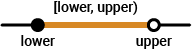
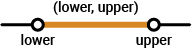
Type of interval that defines the range of allowed values, specified as one of the values in this table.
Type of Interval | Diagram | Description |
|---|---|---|
|
| Include |
|
| Exclude |
|
| Exclude
|
|
| Include
|
Table or timetable variables to operate on, specified as one of the values in this table.
allbetween operates only on elements in the specified
variables in A.
| Indexing Scheme | Values to Specify | Examples |
|---|---|---|
Variable name |
|
|
Variable index |
|
|
Function handle |
|
|
Variable type |
|
|
Example: tf = allbetween(T,lower,upper,DataVariables=["Var1" "Var2"
"Var4"]) determines if the elements in the Var1,
Var2, and Var4 variables in table
T are within the specified range.
Output Arguments
Indicator that all values are within range, returned as a logical scalar.
tf is logical 1 (true) if all
elements in A are within the range defined by the lower and upper
bounds. Otherwise, tf is logical 0
(false).
Data Types: logical
Extended Capabilities
Usage notes and limitations:
Input data or bounds of type
datetimeordurationis not supported.
Refer to the usage notes and limitations in the C/C++ Code Generation section. The same usage notes and limitations apply to GPU code generation.
The
allbetween function fully supports GPU arrays.
To run the function on a GPU, specify the input data as a gpuArray (Parallel Computing Toolbox). For more
information, see Run MATLAB Functions on a GPU (Parallel Computing Toolbox).
The
allbetween function fully supports distributed arrays. For more
information, see Run MATLAB Functions with Distributed Arrays (Parallel Computing Toolbox).
Version History
Introduced in R2025aGenerate C or C++ code for the allbetween function. For usage
notes and limitations, see C/C++ Code Generation.
MATLAB Command
You clicked a link that corresponds to this MATLAB command:
Run the command by entering it in the MATLAB Command Window. Web browsers do not support MATLAB commands.
Select a Web Site
Choose a web site to get translated content where available and see local events and offers. Based on your location, we recommend that you select: .
You can also select a web site from the following list
How to Get Best Site Performance
Select the China site (in Chinese or English) for best site performance. Other MathWorks country sites are not optimized for visits from your location.
Americas
- América Latina (Español)
- Canada (English)
- United States (English)
Europe
- Belgium (English)
- Denmark (English)
- Deutschland (Deutsch)
- España (Español)
- Finland (English)
- France (Français)
- Ireland (English)
- Italia (Italiano)
- Luxembourg (English)
- Netherlands (English)
- Norway (English)
- Österreich (Deutsch)
- Portugal (English)
- Sweden (English)
- Switzerland
- United Kingdom (English)
![Closed interval [lower, upper]](interval-notation-02.png)
![Half-open interval (lower, upper]](interval-notation-04.png)