legendreP
R2026bLegendre polynomials
Syntax
Description
y = legendreP(n,x)nth degree Legendre
polynomial at x.
Examples
Find the Legendre polynomial of degree 3 at 5.6.
y = legendreP(3,5.6)
y =
430.6400
Find the Legendre polynomial of degree 2 at x.
syms x
y = legendreP(2,x)
y =
If you do not specify a numerical value for the degree n, the legendreP function cannot find the explicit form of the polynomial and returns the function call.
syms n
y = legendreP(n,x)
y =
Find the Legendre polynomials of degrees 1 and 2 by setting n = [1 2].
syms x
y = legendreP([1 2],x)
y =
legendreP acts element-wise on n to return a vector with two elements.
If multiple inputs are specified as a vector, matrix, or multidimensional array, the inputs must be the same size. Find the Legendre polynomials where input arguments n and x are matrices.
n = [2 3; 1 2];
xM = [x^2 11/7; -3.2 -x];
yM = legendreP(n,xM)
yM =
legendreP acts element-wise on n and x to return a matrix of the same size as n and x.
Use limit to find the limit of a Legendre polynomial of degree 3 as x tends to .
syms x
P3 = legendreP(3,x);
P3 = limit(P3,x,-Inf)
P3 =
Use diff to find the third derivative of the Legendre polynomial of degree 5.
P5 = legendreP(5,x);
D3P5 = diff(P5,x,3)
D3P5 =
Use taylor to find the Taylor series expansion of the Legendre polynomial of degree 2 at x = 0.
syms x
y = legendreP(2,x)
y =
t = taylor(y,x)
t =
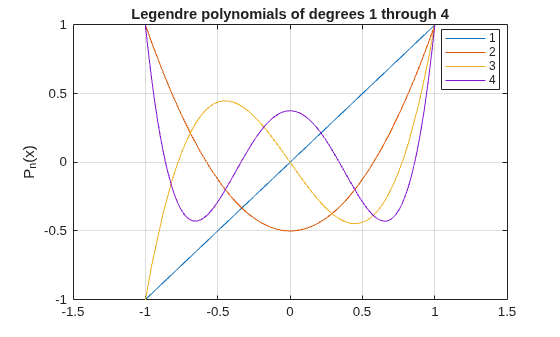
Plot Legendre polynomials of orders 1 through 4.
syms x y
fplot(legendreP(1:4, x))
axis([-1.5 1.5 -1 1])
grid on

ylabel('P_n(x)')
title('Legendre polynomials of degrees 1 through 4')
legend('1','2','3','4','Location','best')
Use vpasolve to find the roots of the Legendre polynomial of degree 7.
syms x
roots = vpasolve(legendreP(7,x) == 0)
roots =
Input Arguments
Output Arguments
More About
Version History
Introduced in R2014b
See Also
chebyshevT | chebyshevU | gegenbauerC | hermiteH | hypergeom | jacobiP | laguerreL

