ellipap
R2026bElliptic analog lowpass filter prototype
Description
Examples
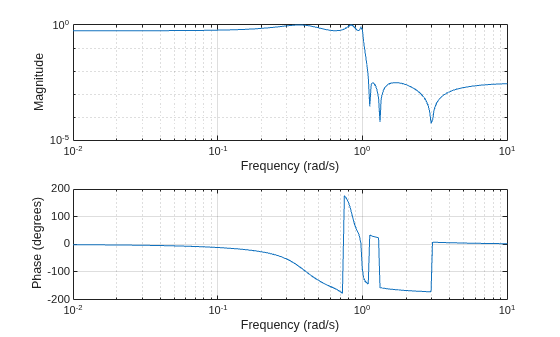
Design a 6th-order elliptic analog lowpass filter with 5 dB of ripple in the passband and 50 dB of stopband attenuation.
[z,p,k] = ellipap(6,5,50);
Convert the zero-pole-gain filter parameters to transfer function form and display the frequency response of the filter.
[b,a] = zp2tf(z,p,k);
freqs(b,a)
Input Arguments
Output Arguments
Algorithms
The ellipap function uses the algorithm outlined in [1]. It
employs ellipke to calculate the complete elliptic
integral of the first kind [2] and uses elliptic
functions to compute the zeros and poles.
The function sets the passband edge angular frequency ωp of the elliptic filter to 1 for a normalized result and finds a value for the stopband edge angular frequency ωs. At these frequencies, the filter magnitude response has a passband ripple and stopband attenuation of Rp dB and Rs dB, respectively.
The transfer function in factored zero-pole-gain form is
As part of the filter prototype design process, ellipap verifies
that the filter order n, passband ripple Rp, and
stopband attenuation Rs satisfy
where must be less than 1, , and K(m) is the complete elliptic integral of the first kind with parameter m such that
Note
If you specify too high a value for n,
ellipap can error out. To resolve this error, reduce
n.
References
[1] Parks, T. W., and C. S. Burrus. Digital Filter Design. New York: John Wiley & Sons, 1987, chap. 7.
[2] Abramowitz, Milton, and Stegun, Irene A. Handbook of Mathematical Functions With Formulas, Graphs, and Mathematical Tables. National Bureau of Standards, Applied Mathematical Series, 1972.
Extended Capabilities
Version History
Introduced before R2006a

