Overview of Wi-Fi 8 for PHY Modeling
Innovation in Wi-Fi® technology continues to evolve to meet the growing demands of digital connectivity in homes, businesses, and public hotspots. As these environments increasingly rely on high-performance wireless services, the limitations of previous generations like Wi-Fi 7 and Wi-Fi 6 are more apparent.
With the proliferation of real-time cloud-based services , ultra-high-definition content, and immersive applications such as augmented reality and virtual reality (AR/VR), the demand for ultra-reliable, low-latency, and high-throughput wireless connectivity has intensified. To address these emerging needs, IEEE® has introduced the next standard in wireless networking: Wi-Fi 8, also known as 802.11bn™ or ultra-high reliability (UHR). WLAN Toolbox™ features examples that enable you to model UHR transmissions:
Comparison of Wi-Fi 8 and Wi-Fi 7
Wi-Fi 8 builds on Wi-Fi 7 by introducing important physical layer (PHY) enhancements.
| Characteristic | Wi-Fi 8 | Wi-Fi 7 |
|---|---|---|
| IEEE standard | 802.11bn | 802.11bn |
| Channel bandwidth | Up to 320 MHz | Up to 320 MHz |
| Frequency bands | 2.4, 5, and 6 GHz | 2.4, 5, and 6 GHz |
| Modulation | 4096 quadrature amplitude modulation (QAM) OFDMA | 4096-QAM OFDMA |
| Enhanced long range (ELR) packets | Supported | Not supported |
| Unequal modulation (UEQM) | Supported | Not supported |
| Modulation and coding schemes (MCSs) 17, 19, 20, and 23 | Supported | Not supported |
| Distributed resource units (DRUs) | Supported | Not supported |
| Maximum LDPC codeword size | 3888 | 1944 |
Key Characteristics of Wi-Fi 8 PHY
These key PHY characteristics distinguish Wi-Fi 8 from its predecessors.
ELR Packets
UHR ELR packet offers improved reliability and wider coverage. For information on how a UHR ELR packet differs from UHR multi-user (UHR MU) and UHR trigger-based (UHR TB) packets, see UHR PPDU Structure.
Unequal Modulation
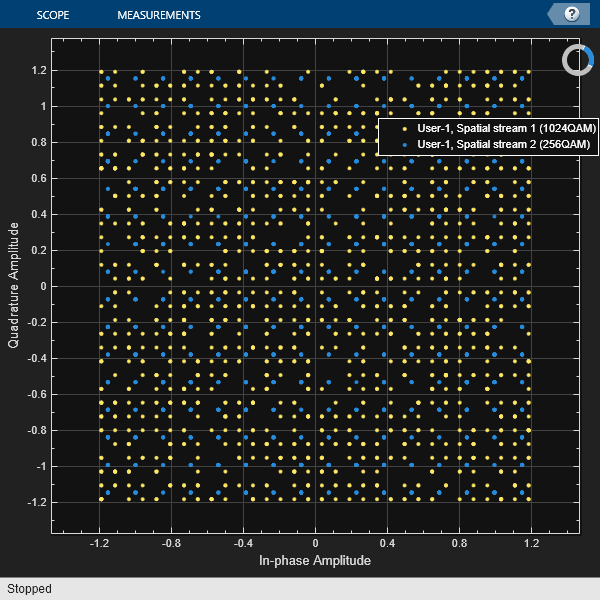
UEQM enables different spatial streams to have different modulation types. You can improve data rates and reliability by assigning higher modulation orders to spatial streams with better channel conditions. UEQM applies only to UHR MU packets that use a non-MU-MIMO beamformed transmission. This constellation diagram shows two spatial streams with different modulation orders.
New Modulation and Coding Schemes
Wi-Fi 8 supports four new MCSs. Wi-Fi 8 does not introduce new modulation types, but the combinations of modulation type and code rate are new. The new MCSs apply to both EQM and UEQM. Since UEQM requires the code rate to be the same across all spatial streams, the new MCSs give more options for UEQM. MCSs 17 and above are new.
| MCS Index | Modulation Type | Code Rate |
|---|---|---|
| 0 | Binary phase shift keying (BPSK) | 1/2 |
| 1 | Quadrature phase shift keying (QPSK) | 1/2 |
| 2 | 3/4 | |
| 3 | 16-QAM | 1/2 |
| 4 | 3/4 | |
| 5 | 64-QAM | 2/3 |
| 6 | 2/4 | |
| 7 | 5/6 | |
| 8 | 256-QAM | 3/4 |
| 9 | 5/6 | |
| 10 | 1024-QAM | 3/4 |
| 11 | 5/6 | |
| 12 | 4096-QAM | 3/4 |
| 13 | 5/6 | |
| 15 | BPSK with dual carrier modulation (BPSK-DCM) | 1/2 |
| 17 | QPSK | 2/3 |
| 19 | 16-QAM | 2/3 |
| 20 | 5/6 | |
| 23 | 256-QAM | 2/3 |
Distributed Resource Units
In a DRU, the tones that make up the RU are evenly spread across the whole channel bandwidth.
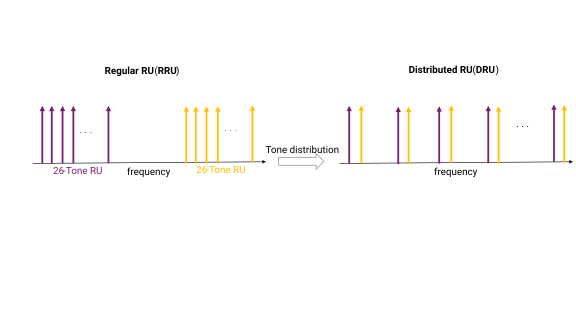
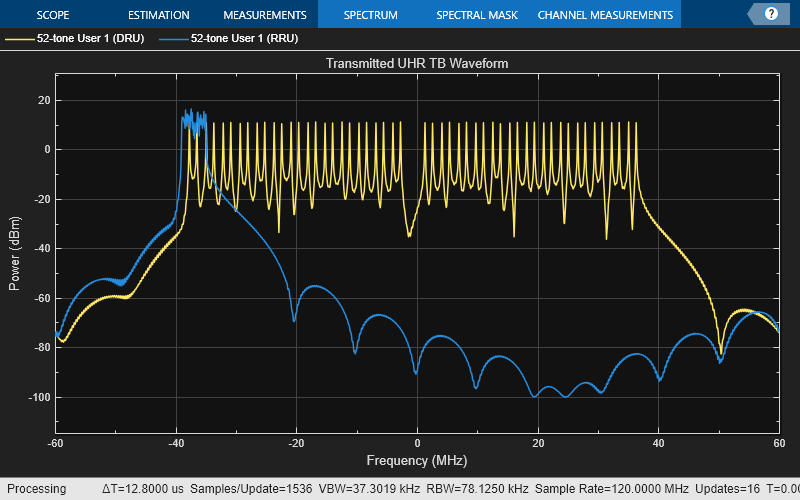
Spreading the tones over a wider spectrum minimizes the number of tones per unit channel bandwidth. Since the power spectral density of a frequency-domain signal is defined as the power per unit bandwidth, the tones can be transmitted with a higher power level while keeping the power spectral density the same. This way, bands with power spectral density limits can have higher-power transmissions. For example, in this spectrum plot, you can see that the power of the DRU (yellow) is spread over a much wider bandwidth than that of the RRU (blue).
Longer LDPC Codewords
Wi-Fi introduces a new low-density parity check (LDPC) codeword size of 3888. You can use this codeword size along with the three previous Wi-Fi 7 values of 648, 1294, and 1944.