wlanHTLTFChannelEstimate
R2026bChannel estimation using HT-LTF
Syntax
Description
Examples
Estimate and plot the channel coefficients of an HT-mixed format channel by using the high throughput long training field.
Create an HT format configuration object. Generate the corresponding HT-LTF based on the object.
cfg = wlanHTConfig;
txSig = wlanHTLTF(cfg);
Multiply the transmitted HT-LTF signal by 0.2 + 0.1i and pass it through an AWGN channel. Demodulate the received signal.
rxSig = awgn(txSig*(0.2+0.1i),30);
demodSig = wlanHTLTFDemodulate(rxSig,cfg);
Estimate the channel response using the demodulated HT-LTF.
chanEst = wlanHTLTFChannelEstimate(demodSig,cfg);
Plot the channel estimate.
scatterplot(chanEst)
grid
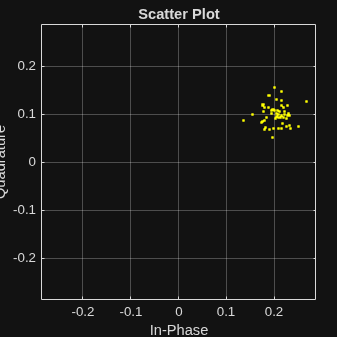
The channel estimate matches the complex channel multiplier.
Estimate the channel coefficients of a 2x2 MIMO channel by using the high throughput long training field. Recover the HT-data field and determine the number of bit errors.
Create an HT-mixed format configuration object for a channel having two spatial streams and four transmit antennas. Transmit a complete HT waveform.
cfg = wlanHTConfig('NumTransmitAntennas',2, ...
    'NumSpaceTimeStreams',2,'MCS',11);
txPSDU = randi([0 1],8*cfg.PSDULength,1);
txWaveform = wlanWaveformGenerator(txPSDU,cfg);
Pass the transmitted waveform through a 2x2 TGn channel.
tgnChan = wlanTGnChannel('SampleRate',20e6, ...
    'NumTransmitAntennas',2, ...
    'NumReceiveAntennas',2, ...
    'LargeScaleFadingEffect','Pathloss and shadowing', ...
    'NormalizeChannelOutputs',false);
rxWaveformNoNoise = tgnChan(txWaveform);
Add AWGN to the received signal.
snrdB = 80; % SNR (dB)
% Convert the SNR per active subcarrier to total SNR to account for noise energy in null subcarriers
ofdmInfo = wlanHTOFDMInfo("HT-LTF",cfg);
snrValue = convertSNR(snrdB,"snrsc","snr",FFTLength=ofdmInfo.FFTLength,NumActiveSubcarriers=ofdmInfo.NumTones);
nVar = 10^((-snrValue-30)/10); % Noise variance (W) for 0 dBm (-30 dBW) signal power
rxWaveform = awgn(rxWaveformNoNoise,snrValue);
Determine the indices for the HT-LTF. Extract the HT-LTF from the received waveform. Demodulate the HT-LTF.
indLTF  = wlanFieldIndices(cfg,'HT-LTF');
rxLTF = rxWaveform(indLTF(1):indLTF(2),:);
ltfDemodSig = wlanHTLTFDemodulate(rxLTF,cfg);
Generate the channel estimate by using the demodulated HT-LTF signal. Specify a smoothing filter span of three subcarriers.
chanEst = wlanHTLTFChannelEstimate(ltfDemodSig,cfg,3);
Extract the HT-data field from the received waveform.
indData = wlanFieldIndices(cfg,'HT-Data');
rxDataField = rxWaveform(indData(1):indData(2),:);
Recover the data and verify that there no bit errors occurred.
rxPSDU = wlanHTDataRecover(rxDataField,chanEst,nVar,cfg);

numErrs = biterr(txPSDU,rxPSDU)
numErrs =
0
Input Arguments
Output Arguments
More About
References
[1] IEEE Std 802.11™-2012 IEEE Standard for Information technology — Telecommunications and information exchange between systems, Local and metropolitan area networks — Specific requirements — Part 11: Wireless LAN Medium Access Control (MAC) and Physical Layer (PHY) Specifications.
[2] Perahia, E., and R. Stacey. Next Generation Wireless LANs: 802.11n and 802.11ac . 2nd Edition, United Kingdom: Cambridge University Press, 2013.
Extended Capabilities
Version History
Introduced in R2015bSee Also
1 IEEE Std 802.11-2020 Adapted and reprinted with permission from IEEE. Copyright IEEE 2020. All rights reserved.
2 © IEEE 2021. All rights reserved.

