adversarialOptions
Options for finding adversarial examples for MATLAB deep neural networks
Since R2026a
Syntax
Description
Add-On Required: This feature requires the AI Verification Library for Deep Learning Toolbox add-on.
returns options for finding adversarial examples for MATLAB® deep neural networks using the algorithm specified by
options = adversarialOptions(algorithmName)algorithmName. To find adversarial examples, use the adversarial
options as an input argument to the findAdversarialExamples function.
returns adversarial options with additional options specified by one of more name-value
arguments.options = adversarialOptions(algorithmName,Name=Value)
Examples
Create a set of options for finding adversarial examples using the BIM algorithm. Set the step size to 20, the number of iterations to 10, and the mini-batch size to 64.
options = adversarialOptions("bim",StepSize=20,NumIterations=10,MiniBatchSize=64)options =
AdversarialOptionsBIM with properties:
StepSize: 20
NumIterations: 10
MiniBatchSize: 64
ExecutionEnvironment: 'auto'
Verbose: 0
Create a set of options for finding adversarial examples using the FGSM algorithm. Set the step size to 20 and the mini-batch size to 64.
options = adversarialOptions("fgsm",StepSize=20,MiniBatchSize=64)options =
AdversarialOptionsFGSM with properties:
StepSize: 20
MiniBatchSize: 64
ExecutionEnvironment: 'auto'
Verbose: 0
Load a pretrained network. This network has been trained to classify natural RGB images.
rng("default")
[net,classNames] = imagePretrainedNetwork;
inputSize = net.Layers(1).InputSize(1:2);Load a test image and resize it to the expected network input size. This is an image of a golden retriever.
img = imread("sherlock.jpg"); img = imresize(img,inputSize); X = dlarray(single(img),"SSCB"); label = categorical("golden retriever",classNames);
Find the label predicted by the network.
score = predict(net,X); YTest = scores2label(score,classNames)
YTest = categorical
golden retriever
This image has values in the range [0 255]. Generate lower and upper bounds with a maximum perturbation size of ∓10. Ensure that the values do not go below 0 or above 255.
perturbationSize = 10; XLower = max(X-perturbationSize,0); XUpper = min(X+perturbationSize,255);
The default step size is suitable for inputs with values between [0,1]. As this input has values with a maximum of 255, create an adversarial options object with a step size of 1 and number of iterations set to 2.
options = adversarialOptions("bim",StepSize=1,NumIterations=2);
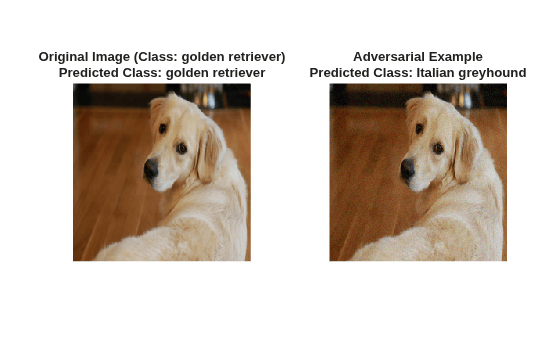
[example,mislabel] = findAdversarialExamples(net,XLower,XUpper,label,Algorithm=options);View the original image and the adversarial example side-by-side. The adversarial example is misclassified even though the adversarial image appears very similar to the original image.
figure
tiledlayout(1,2);
nexttile(1);
imshow(img);
title({"Original Image (Class: " + string(label) + ")", ...
"Predicted Class: " + string(YTest)});
nexttile(2)
imshow(uint8(extractdata(example)));
title({"Adversarial Example", "Predicted Class: " + string(mislabel)});
Input Arguments
Algorithm to generate adversarial examples, specified as a character vector or string scalar.
"bim"— Basic iterative method"fgsm"— Fast gradient sign method
For more information on the algorithms, see Adversarial Examples.
Name-Value Arguments
Specify optional pairs of arguments as
Name1=Value1,...,NameN=ValueN, where Name is
the argument name and Value is the corresponding value.
Name-value arguments must appear after other arguments, but the order of the
pairs does not matter.
Example: options = adversarialOptions("fgsm",MiniBatchSize=32) returns
an AdversarialOptionsFGSM object with the
MiniBatchSize property set to 32.
General Options
Size of mini-batches to use for generating adversarial examples, specified as a positive integer. Larger mini-batch sizes require more memory, but can lead to faster performance.
Data Types: single | double | int8 | int16 | int32 | int64 | uint8 | uint16 | uint32 | uint64
Hardware resource for generating adversarial examples, specified as one of these values:
"auto"– Use a local GPU if one is available. Otherwise, use the local CPU."cpu"– Use the local CPU."gpu"– Use the local GPU."multi-gpu"– Use multiple GPUs on one machine, using a local parallel pool based on your default cluster profile. If there is no current parallel pool, the software starts a parallel pool with pool size equal to the number of available GPUs."parallel-auto"– Use a local or remote parallel pool. If there is no current parallel pool, the software starts one using the default cluster profile. If the pool has access to GPUs, then only workers with a unique GPU perform training computation and excess workers become idle. If the pool does not have GPUs, then training takes place on all available CPU workers instead."parallel-cpu"– Use CPU resources in a local or remote parallel pool, ignoring any GPUs. If there is no current parallel pool, the software starts one using the default cluster profile."parallel-gpu"– Use GPUs in a local or remote parallel pool. Excess workers become idle. If there is no current parallel pool, the software starts one using the default cluster profile.
The "gpu", "multi-gpu",
"parallel-auto", "parallel-cpu", and
"parallel-gpu" options require Parallel Computing Toolbox™. To use a GPU for deep
learning, you must also have a supported GPU device. For information on supported
devices, see GPU Computing Requirements (Parallel Computing Toolbox). If
you choose one of these options and Parallel Computing Toolbox or a suitable GPU is not available, then the software returns an
error.
For more information on when to use the different execution environments, see Scale Up Deep Learning in Parallel, on GPUs, and in the Cloud.
Step size used to generate adversarial examples, specified as a positive scalar.
For more information on the effect of the step size, see Adversarial Examples.
Data Types: single | double | int8 | int16 | int32 | int64 | uint8 | uint16 | uint32 | uint64
Option to enable verbose output, specified as a numeric or logical
1 (true) or 0
(false). When you set this input to 1
(true), the function returns its progress by indicating which
mini-batch the function is processing and the total number of mini-batches. The
function also returns the amount of time computation takes.
Data Types: single | double | int8 | int16 | int32 | int64 | uint8 | uint16 | uint32 | uint64 | logical
BIM Options
Number of iterations used to generate adversarial examples using the basic iterative method (BIM), specified as a positive integer.
You can only specify this option if you set the algorithmName
argument to "bim".
Data Types: int8 | int16 | int32 | int64 | uint8 | uint16 | uint32 | uint64
Output Arguments
Adversarial options, returned as an AdversarialOptionsFGSM or
AdversarialOptionsBIM object. To generate adversarial examples, use
the adversarial options as an input argument to the findAdversarialExamples function.
Version History
Introduced in R2026a
MATLAB Command
You clicked a link that corresponds to this MATLAB command:
Run the command by entering it in the MATLAB Command Window. Web browsers do not support MATLAB commands.
Select a Web Site
Choose a web site to get translated content where available and see local events and offers. Based on your location, we recommend that you select: .
You can also select a web site from the following list
How to Get Best Site Performance
Select the China site (in Chinese or English) for best site performance. Other MathWorks country sites are not optimized for visits from your location.
Americas
- América Latina (Español)
- Canada (English)
- United States (English)
Europe
- Belgium (English)
- Denmark (English)
- Deutschland (Deutsch)
- España (Español)
- Finland (English)
- France (Français)
- Ireland (English)
- Italia (Italiano)
- Luxembourg (English)
- Netherlands (English)
- Norway (English)
- Österreich (Deutsch)
- Portugal (English)
- Sweden (English)
- Switzerland
- United Kingdom (English)