comm.CPMModulator
Modulate signal using CPM method
Description
The comm.CPMModulator
System object™ modulates an input signal using the continuous phase modulation (CPM)
method. The output is a baseband representation of the modulated signal. For more
information about the modulation and filtering applied, see Algorithms.
To modulate a signal using the CPM method:
Create the
comm.CPMModulatorobject and set its properties.Call the object with arguments, as if it were a function.
To learn more about how System objects work, see What Are System Objects?
Creation
Syntax
Description
cpmmod = comm.CPMModulator creates a modulator
System object to modulate input signals using the CPM method.
cpmmod = comm.CPMModulator(
sets properties using one or more name-value arguments. For example,
Name=Value)comm.CPMModulator(SymbolMapping='Gray') configures the
object with gray-coded symbol ordering for the modulated symbols.
cpmmod = comm.CPMModulator(
sets the M,Name=Value)ModulationOrder
property to M and optional name-value arguments.
Properties
Unless otherwise indicated, properties are nontunable, which means you cannot change their
values after calling the object. Objects lock when you call them, and the
release function unlocks them.
If a property is tunable, you can change its value at any time.
For more information on changing property values, see System Design in MATLAB Using System Objects.
Modulation order, specified as a power-of-two scalar. The modulation order M = 2k specifies number of points in the symbol alphabet. k is a positive integer indicating the number of bits per symbol.
Option to provide input data as bits, specified as 0
(false) or 1
(true).
Set this property to
falseto output data as integers.Set this property to
trueto output data as bits.
For more information, see Integer-Valued and Binary-Valued Input Signals
Symbol mapping, specified as 'Binary' or
'Gray'. This property determines how each integer
maps to a group of output bits.
Set this property to
'Binary'to map symbols using binary-coded ordering.Set this property to
'Gray'to map symbols using Gray-coded ordering.
Dependencies
To enable this property, set the BitInput
property to true.
Modulation index {hi}, specified as a nonnegative scalar or column vector. The modulator operates in multi-h. For more information, see CPM Method.
Type of frequency pulse shaping used by the modulator to smooth the phase
transitions of the modulated signal, specified as
'Rectangular', 'Raised Cosine',
'Spectral Raised Cosine',
'Gaussian', or 'Tamed FM'. For
more information, see Pulse Shape Filtering.
Main lobe duration of the largest lobe in the spectral raised cosine pulse, specified as a positive integer representing the number of symbol intervals used by the modulator to pulse-shape the modulated signal.
Dependencies
To enable this property, set the FrequencyPulse property to 'Spectral Raised
Cosine'.
Roll-off factor of the spectral raised cosine pulse, specified as a scalar in the range [0, 1].
Dependencies
To enable this property, set the FrequencyPulse property to 'Spectral Raised
Cosine'.
Product of the bandwidth and symbol time of the Gaussian pulse shape,
specified as a positive scalar. Use
BandwidthTimeProduct to reduce the bandwidth, at
the expense of increased intersymbol interference.
Dependencies
To enable this property, set the FrequencyPulse property to
'Gaussian'.
Length of the frequency pulse shape in symbol intervals, specified as a positive integer. For more information on the frequency pulse length, refer to LT in Pulse Shape Filtering.
Symbol prehistory, specified as a scalar or vector with odd integer
elements. Values must be in the range [–(M – 1), (M –
1)]. M is the modulation order specified by
ModulationOrder. The SymbolPrehistory
property defines the data symbols used by the modulator before the first
call of the object, in reverse chronological order.
A scalar value expands to a vector of length
PulseLength– 1.For a vector, the length must be
PulseLength– 1.
Initial phase offset in radians, specified as a scalar. This parameter value is initial phase offset of the modulated waveform.
Symbol sampling rate, specified as a positive integer. This property specifies the output symbol upsampling factor for each input sample.
Tip
To accurately model nonbinary pulse shapes, specifically pulse shapes other than rectangular, you should set the symbol sampling rate to values greater than 4.
Data type of the output, specified as 'double' or
'single'.
Usage
Syntax
Description
Input Arguments
Input data, specified as an integer scalar or column vector.
When you set
BitInputtofalse, the object accepts odd integers in the range [ –(M–1), (M–1)]. M is the modulation order specified by theModulationOrderproperty.When you set
BitInputtotrue, the object accepts binary-valued inputs that represent integers.
For more information, see Integer-Valued and Binary-Valued Input Signals
This object accepts variable-size inputs. After the object is locked, you can change the frame size (number of rows) of the signal during simulation. For more information, see Variable-Size Signals in Code.
Data Types: single | double | int8 | int16 | int32 | uint8 | uint16 | uint32 | logical
Output Arguments
CPM-modulated baseband signal, returned as a column vector. The
modulated output symbols are oversampled by the SamplesPerSymbol property value. Use the OutputDataType property to specify the output data
type.
Data Types: double | single
Complex Number Support: Yes
Object Functions
To use an object function, specify the
System object as the first input argument. For
example, to release system resources of a System object named obj, use
this syntax:
release(obj)
Examples
Create CPM modulator, and CPM demodulator System objects.
cpmmodulator = comm.CPMModulator(8, ... 'BitInput',true, ... 'SymbolMapping','Gray'); cpmdemodulator = comm.CPMDemodulator(8, ... 'BitOutput',true, ... 'SymbolMapping','Gray');
Create an error rate calculator System object™, that accounts for the delay caused by the Viterbi algorithm.
delay = log2(cpmdemodulator.ModulationOrder) ... * cpmdemodulator.TracebackDepth; errorRate = comm.ErrorRate('ReceiveDelay',delay);
Transmit 100 3-bit words and print the error rate results.
for counter = 1:100 data = randi([0 1],300,1); modSignal = cpmmodulator(data); noisySignal = awgn(modSignal,0); receivedData = cpmdemodulator(noisySignal); errorStats = errorRate(data,receivedData); end fprintf('Error rate = %f\nNumber of errors = %d\n', ... errorStats(1),errorStats(2))
Error rate = 0.004474 Number of errors = 134
Using the comm.CPMModulator and comm.CPMDemodulator System objects, apply Gaussian frequency-shift keying (GFSK) modulation and demodulation to random bit data.
Create a GFSK modulator and demodulator pair.
gfskMod = comm.CPMModulator( ... ModulationOrder=2, ... FrequencyPulse='Gaussian', ... BandwidthTimeProduct=0.5, ... ModulationIndex=1, ... BitInput=true); gfskDemod = comm.CPMDemodulator( ... ModulationOrder=2, ... FrequencyPulse='Gaussian', ... BandwidthTimeProduct=0.5, ... ModulationIndex=1, ... BitOutput=true);
Generate random bit data and apply GFSK modulation. Plot the eye diagram of the modulated signal traces.
numSym = 100; x = randi([0 1],numSym*gfskMod.SamplesPerSymbol,1); y = gfskMod(x); eyediagram(y,16)
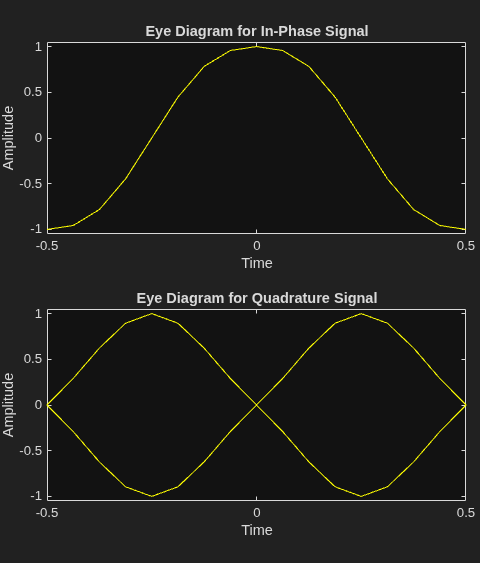
Demodulate the GFSK-modulated data. To verify that the demodulated signal data is equal to the original data, account for the delay introduced by the Gaussian filtering in the GFSK modulation and demodulation processes.
z = gfskDemod(y); delay = finddelay(x,z); isequal(x(1:end-delay),z(delay+1:end))
ans = logical
1
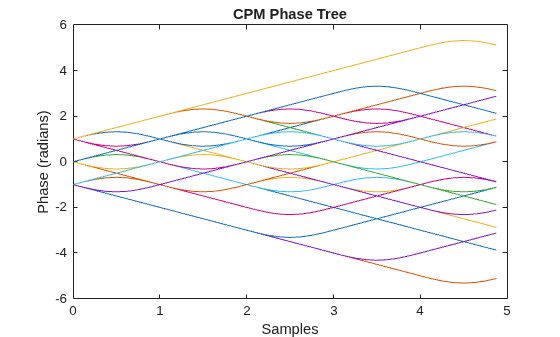
Plot the phase tree diagram for signals that have applied continuous phase modulation (CPM). A phase tree diagram superimposes many curves, each of which plots the phase of a modulated signal over time. The distinct curves result from different inputs to the modulator. This example defines settings for the CPM modulator, applies symbol mapping, and plots the results. Each curve represents a different instance of simulating the CPM modulator with a distinct (constant) input signal.
Define parameters for the example and create a CPM modulator System object™.
M = 2; % Modulation order modindex = 2/3; % Modulation index sps = 8; % Samples per symbol L = 5; % Symbols to display pmat = zeros(L*sps,M^L); % Empty phase matrix cpm = comm.CPMModulator(M, ... ModulationIndex=modindex, ... FrequencyPulse="Raised Cosine", ... PulseLength=2, ... SamplesPerSymbol=sps);
Use a for-loop to apply the mapping of the input symbol to the CPM symbols, mapping 0 to -(M-1), 1 to -(M-2), and so on. Populate the columns of the phase matrix with the unwrapped phase angle of the modulated symbols.
for ip_sig = 0:(M^L)-1 s = int2bit(ip_sig,L,1); s = 2*s + 1 - M; x = cpm(s); pmat(:,ip_sig+1) = unwrap(angle(x(:))); end pmat = pmat/(pi*modindex); t = (0:L*sps-1)'/sps;
Plot the CPM phase tree.
plot(t,pmat); title('CPM Phase Tree') xlabel('Samples') ylabel('Phase (radians)')
More About
When you set BitInput to false:
The input signal must be a column vector of odd integer values in the range [–(M – 1), (M – 1)].
The input signal must have a double-precision, single-precision, or signed-integer data type.
When you set BitInput to true:
The input signal must be a column vector of k-length bit words.
In binary input mode, the object follows this process:
Divide the input bits into k-length bit words and map each bit-group to an integer L in the range [0, M – 1].
Map each nonnegative integer to a k-length binary word using binary-coded ordering or Gray-coded ordering, as specified by the
SymbolMappingproperty.Map each integer L to signed integers as 2L–(M–1).
Proceed with modulation processing as in the integer input mode.
The input signal must have a double-precision, single-precision, integer, or logical data type.
M is the modulation order, as specified by the
ModulationOrder property. The modulation order,
M = 2k
specifies the number of points in the symbol alphabet, where k is a
positive integer indicating the number of bits per symbol.
Algorithms
Continuous phase modulation includes a convolutional encoder, a symbol mapper, and a modulator.
The output of the modulator is a baseband representation of the modulated signal:
where:
{αi} is a sequence of M-ary data symbols selected from the alphabet ±1, ±3, ±(M–1).
M must have the form 2k for some positive integer k, where M is the modulation order and specifies the size of the symbol alphabet.
{hi} is a sequence of modulation indices. hi moves cyclically through a set of indices {h0, h1, h2, ..., hH-1}.
When H=1, only one modulation index exists, h0, which is denoted as h. The phase shift over a symbol is π × h.
When hi varies from interval to interval, the modulator operates in multi-h. To ensure a finite number of phase states, hi must be a rational number.
The CPM method uses pulse shaping to smooth the phase transitions of the modulated signal. The function q(t) is the phase response obtained from the frequency pulse, g(t), through this relation: .
The specified frequency pulse shape corresponds to these pulse shape expressions for g(t).
| Pulse Shape | Expression |
|---|---|
| Rectangular | |
| Raised cosine | |
| Spectral raised cosine | |
| Gaussian | |
| Tamed FM (tamed frequency modulation) |
Lmain is the main lobe pulse duration in symbol intervals.
β is the roll-off factor of the spectral raised cosine.
Bb is the product of the bandwidth and the Gaussian pulse.
The duration of the pulse, LT, is the pulse length in symbol intervals. As defined by the expressions, the spectral raised cosine, Gaussian, and tamed FM pulse shapes have infinite length. For all practical purposes, LT specifies the truncated finite length.
T is the symbol durations.
Q(t) is the complementary cumulative distribution function.
For more information on pulse shape filtering, see [1].
References
[1] Anderson, John B., Tor Aulin, and Carl-Erik Sundberg. Digital Phase Modulation. New York: Plenum Press, 1986.
[2] Proakis, John G. Digital Communications. 5th ed. New York: McGraw Hill, 2007.
Extended Capabilities
Usage notes and limitations:
See System Objects in MATLAB Code Generation (MATLAB Coder).
Version History
Introduced in R2012aThis support enables you to vary the length of input signal each time you call the
object. For more information, see input signal X.
See Also
Objects
Blocks
MATLAB Command
You clicked a link that corresponds to this MATLAB command:
Run the command by entering it in the MATLAB Command Window. Web browsers do not support MATLAB commands.
Select a Web Site
Choose a web site to get translated content where available and see local events and offers. Based on your location, we recommend that you select: .
You can also select a web site from the following list
How to Get Best Site Performance
Select the China site (in Chinese or English) for best site performance. Other MathWorks country sites are not optimized for visits from your location.
Americas
- América Latina (Español)
- Canada (English)
- United States (English)
Europe
- Belgium (English)
- Denmark (English)
- Deutschland (Deutsch)
- España (Español)
- Finland (English)
- France (Français)
- Ireland (English)
- Italia (Italiano)
- Luxembourg (English)
- Netherlands (English)
- Norway (English)
- Österreich (Deutsch)
- Portugal (English)
- Sweden (English)
- Switzerland
- United Kingdom (English)