Configure Language Standard for Target System
R2026bSpecify standard library extensions that the code generator uses for math operations. When you generate code for a new model or with a new configuration set object, the code generator uses the ISO®/IEC 9899:1999 C (C99 (ISO)) library by default. For preexisting models and configuration set objects, the code generator uses the library specified by the Language standard parameter.
If your compiler supports the ISO®/IEC 9899:1990 (C89/C90 (ANSI)), ISO/IEC 14882:2003(C++03 (ISO) or ISO/IEC 14882:2011(C++11 (ISO)) math library extensions, you can change the language standard setting. The C++03 (ISO) or C++11 (ISO) library is an option when you select C++ for the programming language. For the selected language standard, the code generator uses a subset of the standard library functions depending on your compiler because compilers provide different implementations of the standard functions.
The C99 library leverages the performance that a compiler offers over standard ANSI C. When using the C99 library, the code generator produces calls to ISO C functions when possible. For example, the generated code calls the function sqrtf(), which operates on single-precision data, instead of sqrt().
To change the library setting, use the Configuration Parameters > Code Generation > Language standard parameter. The command-line equivalent is TargetLangStandard.
Generate and Inspect ANSI C Code
1. Open the example model CStandardMathLib.
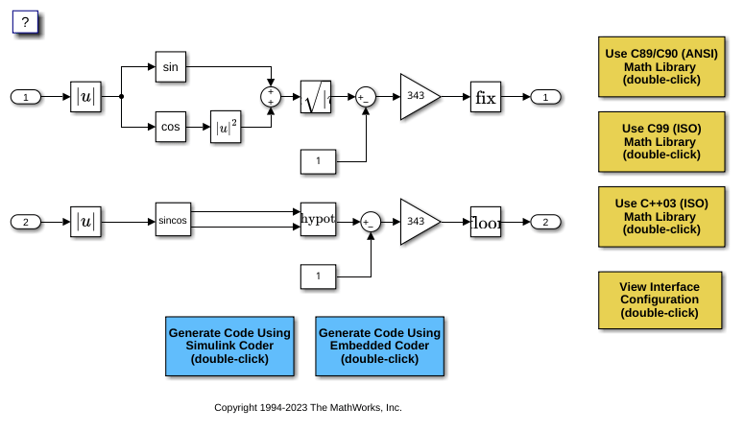
2. Generate code.
### Searching for referenced models in model 'CStandardMathLib'.
### Total of 1 models to build.
### Starting top model code generation target build for: CStandardMathLib
### Successful completion of code generation for: CStandardMathLib

Build Summary

Top model targets:

Model             Build Reason                                Status           Build Duration
=============================================================================================
CStandardMathLib  Target (CStandardMathLib.c) did not exist.  Code generated.  0h 0m 7.2775s

1 of 1 models built (0 models already up to date)
Build duration: 0h 0m 7.9018s
3. Examine the code in the generated file CStandardMathLib.c. Note that the code calls the sqrt function.
  if (rtb_Abs2 < 0.0F) {
    rtb_Abs2 = -(real32_T)sqrt((real32_T)fabs(rtb_Abs2));
  } else {
    rtb_Abs2 = (real32_T)sqrt(rtb_Abs2);
  }

  /* Gain: '<Root>/Gain1' incorporates:
   *  Constant: '<Root>/Constant'
   *  Sqrt: '<Root>/get_hypot1'
   *  Sum: '<Root>/Sum'
   *
   * About '<Root>/get_hypot1':
   *  Operator: signedSqrt
   */
  rtb_Abs2 = (rtb_Abs2 - 1.0F) * 343.0F;

  /* Rounding: '<Root>/fix1' */
  if (rtb_Abs2 < 0.0F) {
    /* Outport: '<Root>/Out1' */
    CStandardMathLib_Y.Out1 = (real32_T)ceil(rtb_Abs2);
  } else {
    /* Outport: '<Root>/Out1' */
    CStandardMathLib_Y.Out1 = (real32_T)floor(rtb_Abs2);
  }

  /* End of Rounding: '<Root>/fix1' */

  /* Abs: '<Root>/Abs2' incorporates:
   *  Inport: '<Root>/In2'
   */
  rtb_Abs2 = (real32_T)fabs(CStandardMathLib_U.In2);

  /* Outport: '<Root>/Out2' incorporates:
   *  Constant: '<Root>/Constant1'
   *  Gain: '<Root>/Gain2'
   *  Math: '<Root>/get_hypot2'
   *  Rounding: '<Root>/fix2'
   *  Sum: '<Root>/Sum2'
   *  Trigonometry: '<S1>/cos'
   *  Trigonometry: '<S1>/sin'
   */
  CStandardMathLib_Y.Out2 = (real32_T)floor((rt_hypotf_snf((real32_T)sin
    (rtb_Abs2), (real32_T)cos(rtb_Abs2)) - 1.0F) * 343.0F);
}

/* Model initialize function */
void CStandardMathLib_initialize(void)
{
  /* Registration code */

  /* initialize non-finites */
  rt_InitInfAndNaN(sizeof(real_T));

  /* initialize error status */
  rtmSetErrorStatus(CStandardMathLib_M, (NULL));

  /* external inputs */
  (void)memset(&CStandardMathLib_U, 0, sizeof(ExtU_CStandardMathLib_T));

  /* external outputs */
  (void)memset(&CStandardMathLib_Y, 0, sizeof(ExtY_CStandardMathLib_T));
}

/* Model terminate function */
void CStandardMathLib_terminate(void)
{
  /* (no terminate code required) */
}
Generate and Inspect ISO C Code
1. Change the setting of Language standard to C99 (ISO). Alternatively, at the command line, set TargetLangStandard to C99 (ISO).
2. Regenerate the code.
### Searching for referenced models in model 'CStandardMathLib'.
### Total of 1 models to build.
### Starting top model code generation target build for: CStandardMathLib
### Successful completion of code generation for: CStandardMathLib

Build Summary

Top model targets:

Model             Build Reason                                Status           Build Duration
=============================================================================================
CStandardMathLib  Target (CStandardMathLib.c) did not exist.  Code generated.  0h 0m 5.6879s

1 of 1 models built (0 models already up to date)
Build duration: 0h 0m 6.2935s
3. Reexamine the code in the generated file CStandardMathLib.c. Now the generated code calls the function sqrtf instead of sqrt.
  if (rtb_Abs2 < 0.0F) {
    rtb_Abs2 = -sqrtf(fabsf(rtb_Abs2));
  } else {
    rtb_Abs2 = sqrtf(rtb_Abs2);
  }

  /* Outport: '<Root>/Out1' incorporates:
   *  Constant: '<Root>/Constant'
   *  Gain: '<Root>/Gain1'
   *  Rounding: '<Root>/fix1'
   *  Sqrt: '<Root>/get_hypot1'
   *  Sum: '<Root>/Sum'
   *
   * About '<Root>/get_hypot1':
   *  Operator: signedSqrt
   */
  CStandardMathLib_Y.Out1 = truncf((rtb_Abs2 - 1.0F) * 343.0F);

  /* Abs: '<Root>/Abs2' incorporates:
   *  Inport: '<Root>/In2'
   */
  rtb_Abs2 = fabsf(CStandardMathLib_U.In2);

  /* Outport: '<Root>/Out2' incorporates:
   *  Constant: '<Root>/Constant1'
   *  Gain: '<Root>/Gain2'
   *  Math: '<Root>/get_hypot2'
   *  Rounding: '<Root>/fix2'
   *  Sum: '<Root>/Sum2'
   *  Trigonometry: '<S1>/cos'
   *  Trigonometry: '<S1>/sin'
   */
  CStandardMathLib_Y.Out2 = floorf((rt_hypotf_snf(sinf(rtb_Abs2), cosf(rtb_Abs2))
    - 1.0F) * 343.0F);
}

/* Model initialize function */
void CStandardMathLib_initialize(void)
{
  /* Registration code */

  /* initialize error status */
  rtmSetErrorStatus(CStandardMathLib_M, (NULL));

  /* external inputs */
  (void)memset(&CStandardMathLib_U, 0, sizeof(ExtU_CStandardMathLib_T));

  /* external outputs */
  (void)memset(&CStandardMathLib_Y, 0, sizeof(ExtY_CStandardMathLib_T));
}

/* Model terminate function */
void CStandardMathLib_terminate(void)
{
  /* (no terminate code required) */
}
Related Information
Override Default Use of Standard Library Functions
For the language standard that you select, the code generator uses a subset of the standard library functions depending on your compiler because compilers provide different implementations of the standard functions. If you want to control which library functions the generated code uses, configure the model to use a code replacement library that specifies the standard library functions to use.

